
Reducing the noise
A scan of a real project returns hundreds of findings. Most are true, and few are yours to fix this week. A lever is a descriptor key or a flag that closes that gap, and each one acts at a fixed phase of a run.
This page follows the ledger CVE from Prioritization: a CVSS 7.5
flaw, high, in a Go module that the ledger component depends on. ledger declares
exposure: internal and criticality: critical, tier C2, so the CVE ranks at P2 until a lever
moves it.
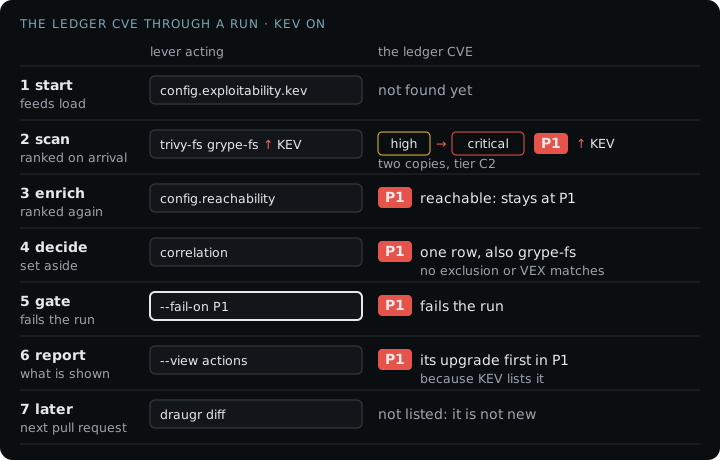
Every lever leaves a record. Ranking keeps every finding and changes its band, removal marks what it
set aside and why, and narrowing changes only what is shown. Start by declaring exposure and
criticality: without them every band is read as though each component were public and critical.
Ranking
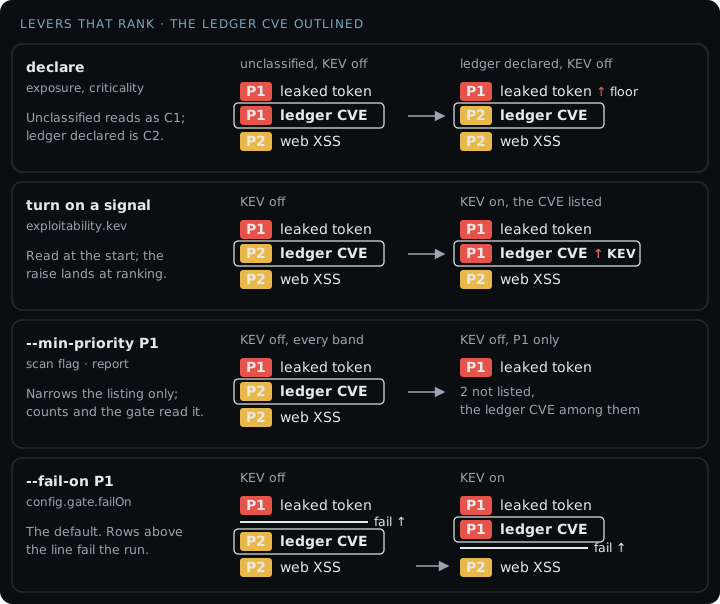
A ranking lever changes a finding's band and keeps every finding in the count. How a band is decided is in Prioritization; the levers here are the ones you pull.
components:
  - name: ledger
    exposure: internal        # public · authenticated · internal · restricted
criticality: critical # critical · important · supporting| lever | does | the ledger CVE | how it works |
|---|---|---|---|
exposure, criticality | sets the component's tier, as each finding is ranked | P1 unclassified, P2 declared | Matrices |
config.exploitability | turns on ↑ KEV and ↑ EPSS; feeds read at start, applied as each finding is ranked | P1 ↑ KEV once listed | Exploitability |
config.dependencyHealth | turns on ↑ malicious and ↑ deprecated, after every scanner finishes | P1 if its package is flagged | Dependency health |
config.reachability | turns on ↓ unreachable, Go only, after every scanner finishes | P2 ↓ unreachable, band held | Reachability |
--min-priority P1 | lists only P1; counts and the gate still read every finding | not listed at P2 | --min-priority |
The two fields are facts about your architecture and your business, which no scanner can compute,
and they sit in the descriptor where a reviewer sees them. A component that declares neither is
ranked as public and critical and marked assumed in the report, as
Components describes. The feeds come from a local cache that
draugr feeds update fills, so a scan never reaches the network for them and the report names the
copy it read.
Removal
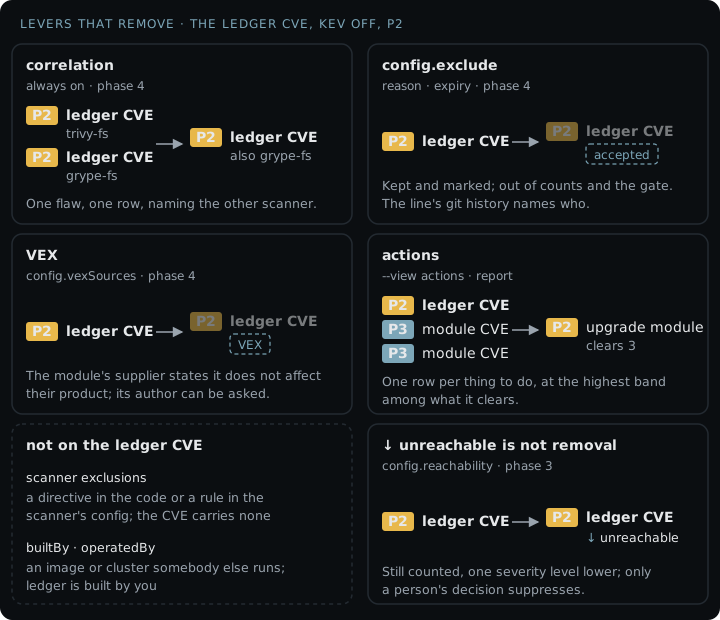
A removal lever makes the count smaller and keeps each finding it removed in the report, with the reason.
| lever | does | applied | the ledger CVE | where |
|---|---|---|---|---|
| correlation | one flaw found by several scanners is one row, naming the others | always on, after every scanner finishes | one row, also grype-fs | Controls & scanners |
config.exclude | accepts a finding with a reason and an expiry; the commit that adds the line records who | after every scanner finishes | marked accepted | Saga schema |
| VEX | imports a supplier's statement that a vulnerability does not affect their product | after every scanner finishes | marked VEX | Saga schema |
| scanner exclusions | a scanner set the finding aside, from a directive in the code or its own configuration | as the scanner reports | none applies | Saga schema |
| actions | findings collapse into the change that clears them | report, --view actions | one upgrade of its module | What to fix first |
builtBy, operatedBy | a finding nobody on your team can act on is named as somebody else's | report | none applies: ledger is yours | What to fix first |
The three acceptance routes are counted apart in every report. config.exclude is a decision
somebody here committed, and the report carries the git history of each exclusion's line as the
record of who. VEX is an assertion whose author you can ask. A scanner exclusion was written outside
the descriptor with no author and no date, the weakest of the three. It splits again by where it was
written, a directive in the scanned file or a rule in the scanner's configuration, because those send
you to different people.
A scanner exclusion is counted only when the scanner keeps a record of it. A #trivy:ignore comment
in an IaC file and a .gitleaksignore entry leave none, so nothing is counted for them.
An unreachable verdict is not a removal: the ledger CVE stays in the count at P2, marked
↓ unreachable, because a suppression records that a person decided.
Narrowing
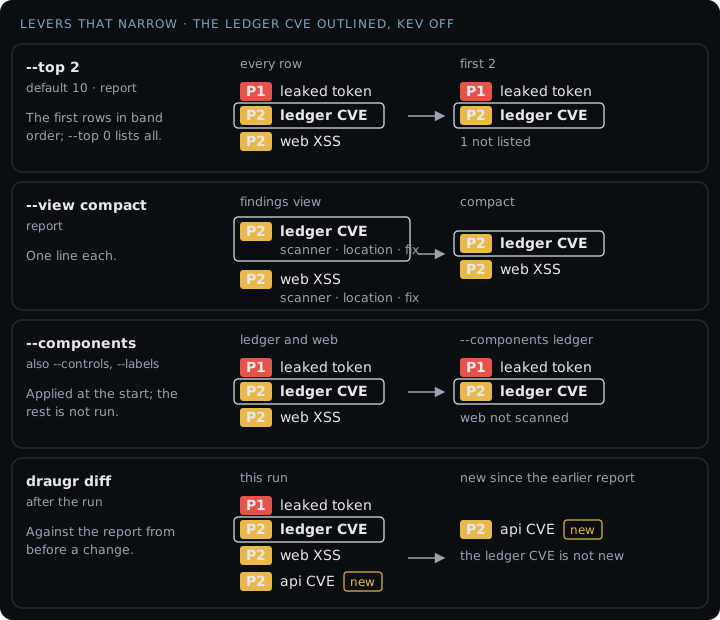
A narrowing lever changes what you are shown, never what was found. The counts describe the whole run, and the report says when a listing is filtered.
| lever | does | applied | the ledger CVE |
|---|---|---|---|
--top 0 | every finding rather than the first ten | report | listed wherever it ranks |
--view actions | a row per thing to do instead of a row per finding | report | inside its module's upgrade |
--view compact | one line each, to see how much there is | report | one line |
--components, --controls | scan one part of the application | start | found when ledger and sca are in scope |
--exposure, --criticality, --labels | scan the components matching a classification | start | found when the filter matches ledger |
draugr diff | only what a change introduced, against a report from before it | after the run | left out once it is in the earlier report |
A pull request that adds no findings needs no report read, whatever the project's standing total,
which makes draugr diff the narrowing lever with the largest effect.
Gate
The gate is the threshold that fails a run: any finding at or above it sets the verdict to
FAIL and the exit code to non-zero. It reads every finding the run kept, after ranking and
removal; narrowing does not change it. A band gate compares a finding's band; a severity gate
compares its ranked severity.
| setting | fails the run on |
|---|---|
--fail-on P1, the default | a finding in P1 |
--fail-on P2, or config.gate.failOn: P2 | a finding in P1 or P2 |
--fail-on critical, or config.gate.failOn: critical | a finding whose ranked severity is critical |
--fail-on high | a finding whose ranked severity is high or critical |
config.gate.controls | a threshold per control, in the gate's own vocabulary; a severity there is compared with the ranked severity |
--fail-on-new, or config.gate.failOnNew | a finding new since --base at or above a band or a ranked severity; this gate alone then decides |
The ledger CVE's list, plus one finding the current change introduced:
| finding | ranked severity | band | --fail-on P1 | --fail-on P2 | --fail-on critical | --fail-on-new P2 |
|---|---|---|---|---|---|---|
| leaked token | high | P1 ↑ floor | fails | fails | passes | passes, not new |
| ledger CVE, KEV off | high | P2 | passes | fails | passes | passes, not new |
| ledger CVE, KEV on | critical | P1 ↑ KEV | fails | fails | fails | passes, not new |
| web XSS | medium | P2 | passes | fails | passes | passes, not new |
| api CVE, new | medium | P2 | passes | fails | passes | fails |
KEV turns the ledger CVE's verdict under --fail-on critical because the gate reads the ranked
severity, not the scanner's high. An unreachable verdict works the other way: an unreachable
critical is judged high and passes --fail-on critical. --min-priority leaves every verdict in
the table as it is, and a ledger CVE accepted through config.exclude or VEX no longer counts
toward any gate. The flags are in scan flags, the
descriptor block is config.gate, and how the verdict and
exit code are reached is in Verdict & gating.
Marks
A mark is the label on the line under a finding that names what moved its ranking, or, for
↩ history, where the finding came from. Each mark is
defined in Signals, with what it moves and the key that turns it on.
| mark | means |
|---|---|
↑ KEV | the CVE is on CISA's Known Exploited Vulnerabilities catalog |
↑ EPSS 0.62 | the EPSS score, printed to two places, is at or above epssThreshold, default 0.5 |
↑ malicious | the package is in the OSSF Malicious Packages Project |
↑ deprecated | the publisher marked the version deprecated |
↓ unreachable | govulncheck found no call path to the flaw, Go only |
↑ floor | a leaked credential, ranked at C1 whatever its component declares |
↑ minimum | a leaked credential, held at high whatever its scanner rated it |
| ↩ history | the finding describes a commit rather than the current tree, so its path may be gone |
Counts
A count that dropped because somebody accepted the ledger CVE and one that dropped because its module was upgraded are different facts, and every Draugr report keeps them apart:
- Accepted findings stay in the report, marked, with the reason and the file and line of the exclusion, whose git history records who wrote it.
- The three acceptance routes are counted separately, never folded into one total.
- A rule that suppressed nothing is reported, because an exclusion doing nothing looks exactly like one that is working.
- An exclusion past its expiry stops suppressing, and the report says so.
- A filtered listing says it was filtered, and the counts still describe the whole run.
- The feeds are named with their fetch time, so a verdict that turned on KEV can be checked against the same copy of KEV.